Carla and Mitch Meredith spent years saving money to buy a custom home in Fort Gibson, about 60 miles southeast of Carla’s hometown of Tulsa. The white farmhouse-style home was built in 2021, and the family moved in soon after.
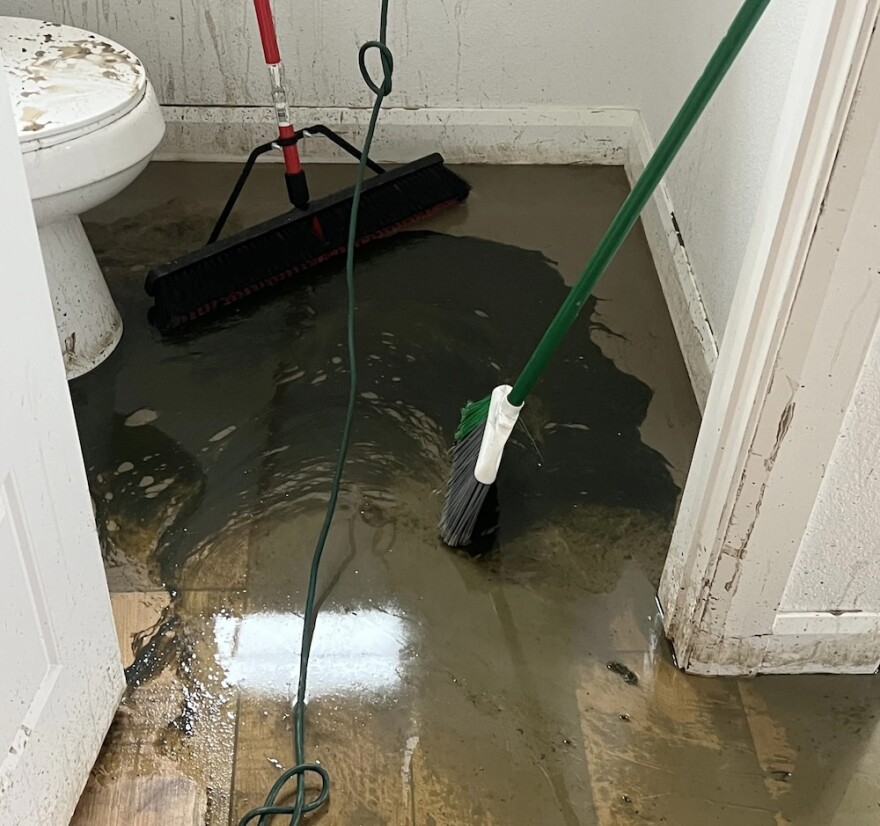
In August 2025, five weeks after the birth of their third child and two days after a small earthquake occurred nearby, a black-gray substance began seeping into the master bathroom.
The liquid appeared to resemble petroleum, and the family feared an abandoned well might be the source of the leak. To avoid contamination, the Merediths have left their home and been living elsewhere for seven months.
The family contacted the Oklahoma Corporation Commission, the state agency responsible for abandoned oil and gas wells. On Aug. 27, a liquid called water was flowing at about 2 gallons per minute, according to commission records.
The agency’s oil and gas division said it had conducted sampling and electromagnetic imaging and examined historical aerial photography and drilling records since the leak began. Officials visited the facility 16 times between August and February.
According to the commission’s sampling, the salt from the liquid is consistent with oil field brine, a byproduct of oil and gas production.
As of April 1, regulators said they had not officially identified the source of the liquid. The commission says there are no records of a well in Meredith’s basement. One of the capped wells was at least 400 feet away and was found dry in the 1940s.
A 1952 aerial photo shows the ground disturbed near where Meredith’s home now stands, as described by Meredith’s attorney, Jana Knott.
The state is estimated to have more than 61,000 unapproved oil and gas wells from its nearly 130-year drilling history. It is not yet clear whether the Merediths’ home was built on it.
In a March 13 news release, the commission suggested that the previously dammed lake and nearby pond “may indicate the possibility of naturally occurring groundwater conditions, including the possibility of an artesian source.”
On March 25, the commission held a public meeting with staff involved in the investigation at the Muskogee Civic Center. Dozens of local residents and neighbors attended. Administrator Jim Marshall told the crowd there was only so much the agency could do to help the Merediths.
“The problem is that the water source is likely under the foundation of your home,” he says. “In order to proceed with the process of plugging a well, assuming it’s a well, you need to be able to access it, so in order to plug the well, you either have to penetrate the foundation or remove the house, including the foundation.”
The Merediths filed suit against their home insurance company and the builder to deny their insurance claim. Still, the families are asking the commission to help contain and manage the problem.
During the meeting, the committee presented the record of its investigation to the audience. Marshall acknowledged the uncertainty surrounding abandoned oil and gas wells in the state, saying some in the audience may own homes over unregistered wells.
“None of us want to go through what the Merediths went through,” he said. “Our hearts go out to this family. We have proven that through comprehensive testing to the best of our ability.”
During an audience question and answer session, Mitch Meredith’s father, Ron Meredith, told Jeremy Hodges, director of the commission’s oil and gas division, about an interaction at the home last fall.

“If you’re trying to think of it as water or a pond or something else, you can’t force that much pressure through that concrete,” Meredith says. “My brother and I fought all weekend to save our home.”
Meredith also asked Hodges if he remembered saying he knew what the liquid was within 15 minutes. Hodges replied, “Yes.”
State Impact requested an interview with Hodges, but was told he was unavailable. He said in a March 19 news release that authorities made exhaustive efforts to determine the source of the liquid.
“This was not an omission, and the OCC fully exercised all available authority and resources,” he said.
After the public meeting, the Merediths had unanswered questions.
“I feel like tonight they didn’t say they were oil and gas, they just said oil and gas in a roundabout way,” Kara Meredith said.

Former Superintendent Brandi Reese was still working for the commission when the family first approached officials about the liquid. The Corporation Commission fired Reese in December without public explanation. He said Meredith’s case, along with oil and gas emergencies across the state, keep him up at night.
“These are all disgusting, scary, environmental issues that, in my opinion, were partly done by bad people and some were just bad practices. We didn’t know any better,” he said. “I think it was just a result of practice. We didn’t know any better.”

Reese said he is talking with lawmakers, including Sen. Avery Frix (R-Muscogee), who authored a bill aimed at helping future Merediths and similar cases. But he said he wished he had known his time on the committee would be cut short.
“If I could go back, I would have at least pushed myself and probably lost my job a little earlier. Who knows?” Hanawa asked. “I think at least now we have Avery. I’ve worked with him for a long time. He’s a go-getter and he’s going to drive this thing to the end.”
“So there’s great hope,” he said.
Senate Bill 1319 would require the commission to establish a redress process for Oklahomans whose “homes have been contaminated by salt water, oil, or other substances within the jurisdiction of the Corporation Commission.” The bill would create a revolving fund for restoration assistance. If the commission determines that a home purchase is necessary, the Commissioner of Lands would acquire the home at fair market value.
Once the house is removed, the Corporation Commission could inspect and plug the well.
The bill passed the Senate floor on March 25, the same night as the public session, and is now before the House. Rep. Chris Snead (R-Fort Gibson) is a co-author of the bill.
“Families should not have to go through such an experience alone or without the support of state regulators,” Flix said in a news release.
The Merediths are involved in the legislative process and are concerned that the bill would give too much power to the committee. Kara reaches out to Flix about her concerns about the law.
“If they’re not willing to assert jurisdiction over my case, then first of all, I don’t really have confidence in how this bill will help me. And secondly, I don’t have confidence in how this bill will help me moving forward because I’ve seen other people not want to be held accountable for something,” she said.
Hall said Corporation Commissioner Kim David has also been involved in discussions about the bill. The agency said in a March 19 news release that David is stepping down from his future role as a judge in order to take a more active role in the legislative process.
At the Muskogee meeting, the Merediths said they first heard from David two weeks ago.
In an email, StateImpact asked the commission whether it would assert jurisdiction over the Merediths’ case and use the funds if the bill went into effect today. A spokesperson said the agency cannot comment on pending legislation.
Another solution proposed by attorney Jana Knott would come from the governor’s office. Gov. Kevin Stitt declared an environmental emergency in Caddo County last fall after disposal wells caused brine cleansing and contaminated nearby water. Several cattle and some wild animals were reported to have died as a result.
Due to the environmental emergency, the Corporation Commission raised funds to remediate the site. Asked if the state could provide a similar response to Meredith’s case, Spokesman Tevis Hillis said there was no emergency funding available to meet the request.
“The governor is thinking of families during this difficult time,” she said.
The Merediths’ suspicions about oil purging beneath their home would not be the first time a well poses a safety risk to homeowners. In 2012, a 71-year-old Tulsa woman was forced to evacuate after a well beneath her home filled the walls with natural gas, causing a fire, according to reports. diary record.

In January 2026, residents of Blanchard were evacuated from their homes after an oil well spouted and caused a gas leak.
Matt Skinner, a former spokesman for the Corporation Commission, told StateImpact last year that as more housing developments are built, more wells are being discovered.
“And as they grow, they hit old abandoned wells. And they may be unplugged, or plugged, but not properly plugged, because they were plugged 100 years ago when no one knew how to plug,” he said.
The Meredith family temporarily lives in a small house owned by the family while they search for a solution. Even if their property is repaired and deemed safe, Carla said she doesn’t see a future in returning to her home.
“It’s difficult, but I have no intention of putting my family back in that house,” Carla said. “We miss home, but we know it’s dangerous and we know God got us out of there. We just had a baby and we had a 5-week-old baby at home.”
“When that happened, I felt like God got us out of it before something really bad happened.”
#family #Oklahoma #oil #contaminating #home #States #hands #tied