Fact-checked by Nick Blackmer
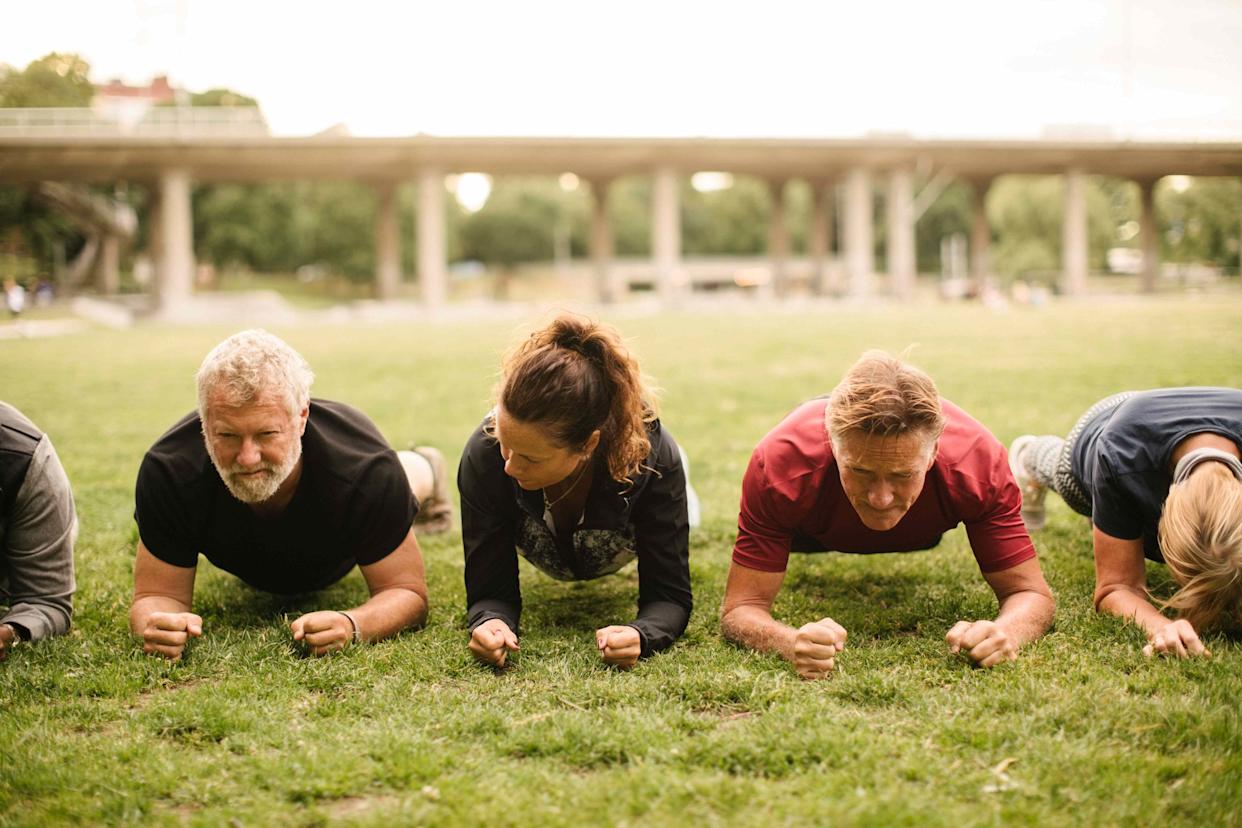
Planks work multiple abdominal muscles at once.
Credit: Maskot / Getty Images
-
Planks work multiple core muscles at the same time, which is essential for maintaining strength and mobility.
-
For young adults, a good standard is to hold the plank for at least 45 seconds. For people over 60, 20 seconds is a solid goal.
-
But ultimately, focusing on correct form is more important than pursuing duration.
If you’ve spent any time on social media lately, you’ve likely come across the plank challenge, where you prop yourself up on your forearms, extend your legs behind you, and hold that position for as long as possible.
Experts warn that focusing too much on plank duration can actually make the exercise less effective, but there are good reasons to aim for strong, stable form and build your endurance over time. So how long should you actually be able to hold a plank? Here’s what you need to know:
What Plank Can Do for You
Evan Williams, CSCS, strength and conditioning coach for the Milwaukee Bucks, said planks are a very effective way to strengthen your core. health.
It’s a highly beneficial exercise, he adds, because it works multiple core muscles at once, including the rectus abdominis (the front of the abdomen), the obliques (the sides), and the transversus abdominis (a deep, stabilizing muscle that wraps around your midsection). This is not the case with many other ab exercises, such as crunches, which tend to target only one area.
Planks also teach you how to properly support and stabilize your core while moving your body. “This is essential for protecting your lower back and maintaining proper alignment during the movement, whether you’re deadlifting at the gym or loading boxes into your car at home,” says Williams.
Focusing on stability becomes even more important as you get older. A small 2012 study found that older adults who completed a nine-week core stabilization program had improved core strength, spinal mobility, and dynamic balance, all important factors in reducing the risk of falls.
How long should you be able to hold a plank?
As with any area of fitness, it’s difficult to give a one-size-fits-all answer when it comes to plank timing. Williams says multiple factors can affect how long you can hold a position, including your body weight and proportions, your overall fitness level, your experience with planks and similar exercises, your muscular endurance, and your breathing control.
Age also plays a big role. Williams says natural changes as we age, such as a decline in muscle mass, strength, and joint health, can affect how long you can hold a plank. “However, with continued training, these declines can be significantly slowed down or even offset,” he added.
While there is no single number that everyone should aim for, there are general ranges that can serve as useful benchmarks. According to Williams, plank hold times are broken down by age as follows:
-
18-39 years old: Generally 45 to 90 seconds or more. 60-120 seconds for healthier people
-
40-59 years old: 30 to 75 seconds for general use. 45-90 seconds for healthier people
-
Over 60 years old: 20 to 60 seconds for general use. 30 to 75 seconds for those with physical strength
how to do plank
It’s easy to get carried away with increasing your plank time, but Williams said the most important thing is the quality of your form, not how long you can hold it.
So what does good form actually look like? Start by stacking the joints. Place your elbows directly under your shoulders and your spine in a neutral position. From there, engage your glutes and quads along with your core, focus on pulling your ribs down, and actively press against the floor to stay stable. If this is difficult, you can try modifications such as kneeling or raising your hands on a sturdy step stool.
One of the most common mistakes people make is not properly anchoring their core, Williams says, which can lead to arching of the lower back and misalignment of the spine. Another common problem is neglecting your upper back and collapsing your shoulders.
“The biggest tip is to focus on proper bracing and full-body tension, actively squeezing your core throughout the movement rather than just holding a position,” Williams said.
In practice, that means holding the plank only as long as you can maintain proper form. If your alignment starts to shift, stop.
How to safely hold a plank for a long time
Once you’ve mastered your form, it’s time to build your endurance. To increase your hold time, start with short planks, such as 15 to 20 seconds, and gradually increase your hold time in 5- to 10-second increments as it starts to feel manageable, Williams says. If your goal is to increase your plank time, try doing 2-3 sets per session and incorporating it into your workouts 2-3 times per week.
However, the board alone cannot do all the work. Incorporating other core-strengthening exercises, such as side planks, bird dogs, dead bugs, and suitcase carries, will strengthen the same muscles and ultimately help you plank for longer.
Finally, remember that long planks aren’t necessarily the ultimate measure of fitness. Williams pointed out that chasing extreme durations (hours for some people) can be counterproductive. That’s because you often end up in a more passive posture, where your whole body becomes less tense just to hold it for a while.
“Most people are better off focusing on high-quality holds,” he says, adding that increasing the difficulty of the exercise by adding movements, such as shoulder taps, for example, can be more effective than simply trying to hold for longer.
Read the original article about health
#long #hold #plank #Heres #compares #age