Since his first day back in the Oval Office, President Donald Trump has made the Arctic one of his top national and economic security priorities. On January 20, 2025, he signed an executive order titled “Unlocking Alaska’s Extraordinary Resource Potential.” In March 2025, he ordered government agencies to promote the production of critical minerals as a national security imperative, specifically approving the Ambler Road project to unlock mineral deposits in remote Alaska, all of which became part of the administration’s key minerals agenda.
The president’s focus on the Arctic extends beyond Alaska, which accounts for one-third of the Arctic Circle. In October 2025, President Trump signed a presidential memorandum authorizing the construction of the Arctic Patrol Cutter and declaring that the United States would restore its status as an “Arctic power.” The cutters will complement the Coast Guard’s fleet of icebreakers and other Arctic-capable vessels. A month later, the administration revived their respective shipbuilding industries with the “ICE Agreement” with Finland and Canada, touted as “the largest and most innovative Arctic and maritime investment in U.S. history.”
President Trump’s interest in acquiring Greenland, whatever his amateurish approach to pursuing the idea and the case, reflects an underlying recognition that the Arctic has become an area of serious strategic competition. Russia maintains the world’s largest icebreaker fleet and has militarized its approach to the north for years. China has declared itself a “near-Arctic nation” and is expanding its reach into the polar regions. Climate change, whether the administration wants to admit it or not, will soon reshape global navigation and choke points by leaving the Arctic ice-free year-round.
The administration has therefore correctly identified its strategic direction in advocating for strengthening America’s Arctic posture. The problem is that the regime’s own policies systematically destroy the operational tools needed to carry out this strategy. In doing so, rather than strengthening the United States’ security posture, it is eroding the United States’ strategic position in the Arctic more effectively than any adversary could hope for.
Risk of adverse effects in DEI erasure
In addition to the rhetorical fireworks with European allies over Greenland, the most recent example of this malfeasance is Secretary of Defense Pete Hegseth’s announcement that he would “sledgehammer” what he called “the oldest DEI program in the federal government,” the Small Business Administration’s 8(a) business development program. He ordered a line-by-line review of all Sole Source 8(a) contracts over $20 million, declaring, “If a contract doesn’t make us more deadly, then it’s gone.” (However, Hegseth admitted in the same announcement that he had never heard of the 8(a) program before.)
Strong oversight of federal contracts is appropriate and necessary, and no program should be isolated from oversight. But widespread suspensions or extended suspensions of 8(a) contracts, particularly in mission-critical categories, would create secondary operational risks in the very areas the administration wants to prioritize. In Alaska in particular, a significant portion of base operations, logistics, construction, and maintenance work flows through local and regional contractors structured to operate under programs including 8(a). Alaska Native Corporations (ANCs) are an important part of that ecosystem.
ANC’s subsidiary provides base operations services including infrastructure maintenance of remote airfields, power generation, and distribution systems at Fort Greeley, home of the nation’s only mainland missile defense facility, the Ground-Based Midcourse Defense System. By Hegseth’s own stated criteria, it is precisely the kind of contract that “makes us more deadly.” But it resides within the very program he promised to destroy. These contract channels support day-to-day operations associated with strategic systems. Without an orderly transition plan, or even if one is in place, disrupting it risks delays, increased costs and short-term readiness, an outcome that is difficult to reconcile with an Arctic strategy predicated on speed and resilience.
Another ANC, NANA Regional Corporation, owns land beneath the Red Dog mine, the world’s largest zinc producer and the largest critical mineral mine in the United States. The mine, located in the Arctic Territory of northwestern Alaska, has been designated a national security priority by President Trump’s Department of the Interior.
Adjusting your strategy
Any serious strategist understands that strategy is the alignment of ends, methods, and means. The idea is to identify objectives and desired end states, develop approaches to achieve them, and organize the necessary resources. When policy initiatives driven by one priority compromise the operational requirements of another, the result is a lack of strategic coherence. This is exactly what is happening in the Arctic. The administration’s stated objectives include strengthening homeland defenses, projecting power into the Arctic, and “controlling” critical minerals. However, the means necessary to achieve these objectives will rely heavily on a contracting ecosystem that includes ANC, which provides base operations, logistics, construction, and maintenance services across Alaska’s defense infrastructure. The “method” the administration has chosen to pursue another goal—classifying 8(a) as a DEI program and attacking it across the board—directly degrades the means upon which its own strategic objectives depend.
This deviation is not a special case. The Greenland episode followed the same logic, albeit slightly differently. The administration correctly identified strategic concerns such as China’s growing investment in critical minerals in Greenland, gaps in the North Atlantic defense reach of the United States and its allies, and Russia’s growing military presence in the Arctic. I had a solid goal. But the execution included public threats against Denmark, talk of military options, and threats of tariffs against NATO allies. As a result, European allies questioned America’s credibility and sought to strengthen their posture in the Arctic without the United States, and the administration ultimately soured relations and withdrew without gaining anything. It was a sound strategic instinct, pursued by means that had the opposite of the intended effect.
The 8(a) episode follows the same pattern, albeit on a smaller scale, but is a slightly different case in which two management objectives collide, with more direct implications for operational readiness. There are also legal aspects that the administration has yet to resolve. The administration’s own SBA general counsel had already concluded in May 2025 that the executive order on DEI programs that likely inspired Hegseth’s knee-jerk “sledgehammer” order “in no uncertain terms does not apply to programs serving Alaska Natives and American Indians, given their status as sovereign political entities under long-settled Supreme Court precedent.” But it is clear that that conclusion did not stop the confusion. Legal incoherence has simply been added to strategic incoherence.
In an era of heightened strategic competition, the administration has articulated a set of defensible Arctic goals. But when a policy actively destroys the means to achieve its stated objectives, its ambitions are not valued. The contractors maintaining Fort Greeley’s missile defense infrastructure are operational assets, not political ornaments to display virtue. The Secretary of Defense would understand this and reach for the scalpel. To return to Hegseth’s own analogy, swinging a sledgehammer at this contract is the operational equivalent of breaking the branch you’re sitting on.
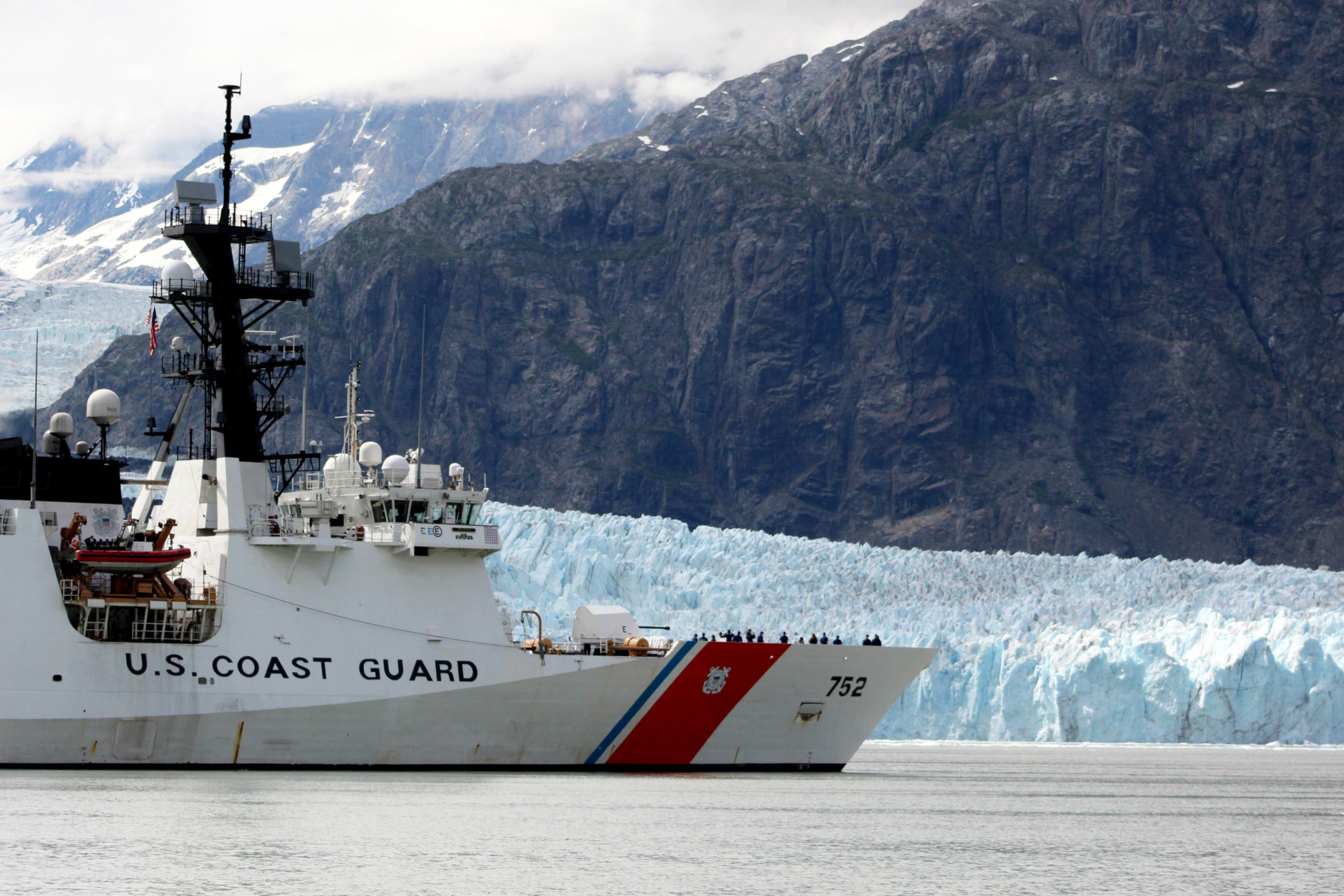
Featured Image: On August 1, 2024, the U.S. Coast Guard Cutter Stratton (WMSL 752) passes through Glacier Bay, Alaska while patrolling the area. (Photo courtesy of the U.S. Coast Guard)
#Trump #administration #sabotaging #Arctic #strategy