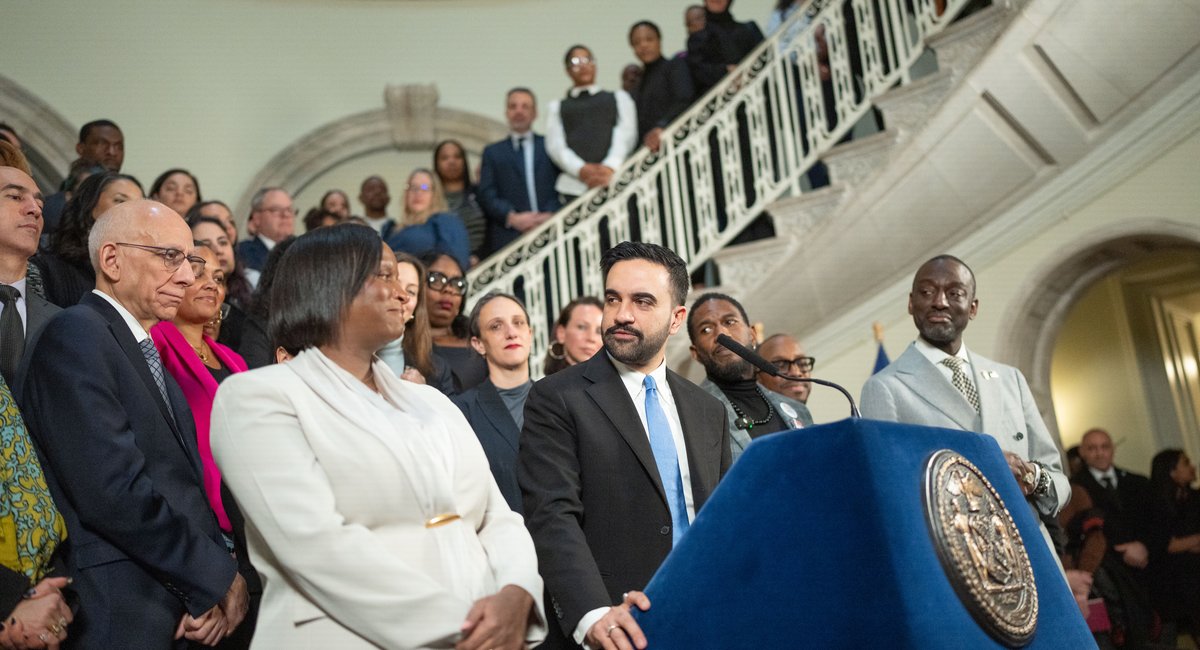
Mayor Zoran Mamdani is betting his public safety legacy on an overhaul of how the city responds to mental health emergencies, but that requires fixing de Blasio-era programs that have failed to deliver on promises for years.
Nearly five years after its creation, the Behavioral Health Emergency Response Division, also known as B-HEARD, has been plagued by problems. The program dispatches mental health professionals and paramedics rather than police to certain mental health emergencies.
But even as more 911 calls were being routed to B-HEARD, the team failed to respond to more than a third of targeted mental health calls, according to a city audit last year. Instead, the city sent police.
Now, Mamdani points to B-HEARD as a core program for the Department of Community Safety, which aims to eliminate the role of police officers in certain mental health emergencies. However, experts familiar with B-HEARD said that scaling up will not be easy.
“They’re going to continue to struggle with the same thing we struggled with, which is expanding B-HEARD,” said Brian Stettin, who advised former Mayor Eric Adams on mental health issues.
Mamdani officials recently rescinded Adams’ order to have B-HEARD run entirely by the city’s health and hospital system, rather than jointly with the FDNY.
Stettin said Adams’ order allows health and hospital staff and ambulances to respond to mental health emergencies. The FDNY faces union rules that require it to send two paramedics to every call. Stettin said the restrictions complicated B-HEARD’s operations due to a long-standing shortage of paramedics.
Dr. Gary Belkin, who oversaw policy for de Blasio’s mental health initiative Thrive from 2014 to 2018, said headline-grabbing crimes could derail efforts to increase mental health training for New Yorkers and the opening of care facilities. He noted that critics may point to incidents of violence involving people with mental illness as evidence that the new approach is not working.
“When the focus is on a worsening crisis, there are movies that give you a feeling of déjà vu over and over again,” Belkin said. “It turns out it could happen again.”
B-HEARD supporters suggest the solution lies in funding, which could prove difficult to resolve amid the city’s more than $5 billion budget shortfall. B-HEARD has been “on its knees for a long time” due to lack of funding and support, Mamdani said at a press conference to announce the new Regional Safety Authority.
The Department of Community Safety will open with just two employees and a budget of $260 million, far less than the $1.1 billion plan proposed by Mamdani as a candidate.
In an interview with Gothamist, Mamdani Chief of Staff El Bisgaard Church said the administration is in the early stages of making “historic changes” to the city’s emergency response. He asserted that authorities are working on a comprehensive approach and are consulting with experts across the country.
“Essentially, the purpose of this regional safety vision is to move upstream,” she said. “It’s about targeting all the root causes that put people in crisis.”
Elizabeth Glaser, who led the mayor’s Office of Criminal Justice during the de Blasio administration, said Mamdani also needs to address how the city supports people with mental illness before and after a crisis.
“If we continue to respond to the crisis, we’ll never be able to address this problem,” said Glaser, who currently runs the urban policy magazine Vital City. “Your purpose is to serve people.”
Under the de Blasio administration, the city introduced a plan to open Support Connection Centers, 24-hour facilities where B-HEARD workers could take people experiencing mental health emergencies. The center offers stays of 5 to 10 days and is an alternative to the hospital.
But the city currently has only one such center in East Harlem, which opened in 2020. Adams added another center in the Bronx in 2022, but closed it due to low traffic, a Department of Health spokeswoman said.
Scott Stringer, a former city inspector and political opponent, compared Mr. Mamdani’s Community Safety Department efforts to one of Mr. de Blasio’s most controversial legacies: prosperity. Thrive faced widespread criticism for a lack of transparency and unclear goals while spending more than $1 billion over six years.
“This feels more like Thrive 2.0,” Stringer said. “If this had been announced during the election period, he would have lost.”
Asked about the lessons officials learned from Thrive, Bisgard-Church said City Hall would be “enthusiastic about the new metrics.”
Correction: An earlier version of this article incorrectly stated funding for community safety agencies. It is expected to receive $260 million.
#Mamdanis #mental #health #plan #hinges #troubled #Blasio #initiative