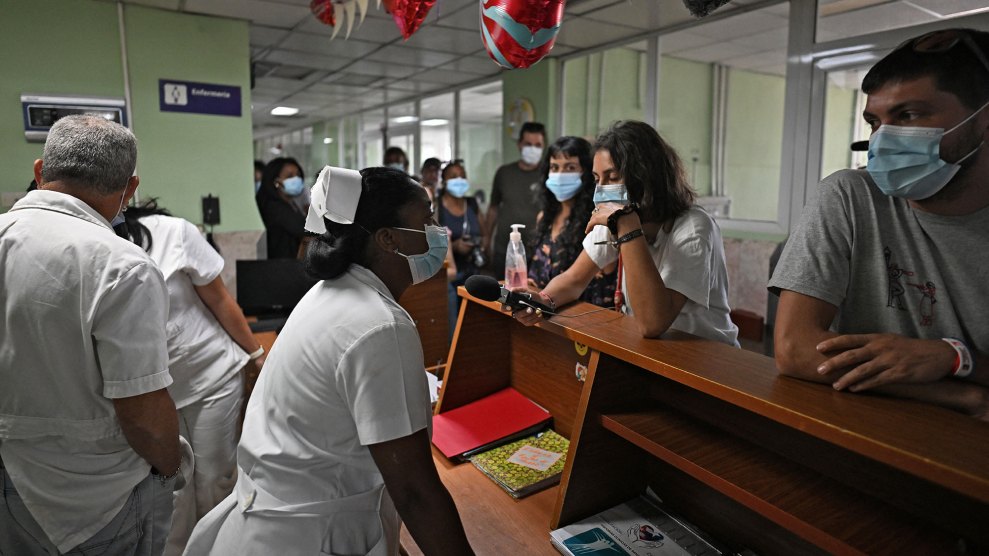
Staff at the William Soler Children’s Heart Center Hospital in Havana, which receives humanitarian aid from Mexico’s Nuestra América convoy, speak with representatives of the convoy in March.Yuri Cortes/AFP/Getty
as the worst of cuba The economic crisis continues to grip the country, with approximately 10 million people enduring nationwide power outages, food shortages, and widespread uncertainty about the country’s political and economic stability. But no infrastructure has been more affected than the island’s health care. Once hailed as one of the world’s best health systems, it has deteriorated over the past decade as many doctors have emigrated to other countries and poor economic policies have exacerbated health care supply shortages. The situation reached a breaking point earlier this year following the US invasion of Venezuela on January 3, 2026. At the time, critical oil supplies to Cuba were cut off, and President Donald Trump threatened to impose punitive tariffs if other countries sent oil to Cuba. The US government has recently softened its stance. new york times It was reported on Monday that decisions on which oil shipments can reach Cuba will be made on a “case-by-case” basis.
The fuel shortage caused power outages across the island that lasted for hours and even days. “We cannot damage the national economy without affecting the population,” Cuba’s Health Minister José Ángel Portal Miranda told The Associated Press. “Lives can be at risk in this situation.” Recent new york times The article documents a myriad of issues affecting patients and health care providers, including clinics struggling to provide treatments such as chemotherapy and dialysis, ambulances left without gas, pregnant women with low birth weight, and delays in vaccinating tens of thousands of children. Last week, World Health Organization Director-General Dr. Tedros Adhanom Ghebreyesus called the situation “very worrying.” “Thousands of surgeries have been postponed over the last month, and the lack of electricity to run the cold chain storage of medical equipment and vaccines has put people in need of care at risk, from cancer patients to pregnant women about to give birth,” he wrote in X.
Economic relations between the United States and Cuba are restricted under a decades-long embargo that began under President John F. Kennedy in 1962 after the failed Bay of Pigs invasion. As we reported last month, the embargo has severely restricted trade with the island. However, some exceptions, such as humanitarian aid, are allowed. Since 1994, the Pittsburgh-based nonprofit Global Links has been transporting medical supplies to Cuba in partnership with the Pan American Health Organization, the WHO Regional Office for the Americas. For more than 30 years, this nonprofit organization has distributed surplus medical products from the U.S. health care system nationally and internationally.
I spoke with Global Links Executive Director Angela Garcia on a Zoom call last week about the organization’s mission to send supplies to Cuban health care providers in recent months. Our interview has been lightly condensed and edited for clarity.
The last time you visited Cuba was in February. During that trip, what struck you most about the ongoing crisis in the country?
Cuba has one of the fastest aging populations. Many elderly people are living in extremely difficult conditions due to emigration and have to cook outdoors over charcoal due to power outages. Malnutrition hits the oldest and youngest populations the hardest. And doctors have fewer options, including triaging surgeries that must be performed due to staffing and power shortages, consolidating hospital services, and triaging which patients receive the highest level of care. They are forced to make decisions like this. More people will die there than before from preventable things. That’s the most heartbreaking thing.
“More people are going to die there from preventable diseases than before. That’s the most heartbreaking thing.”
What are you hearing from frontline health care workers about the situation in health care facilities? What are the most needed resources?
They ask us for very basic things, like gloves for example. Best practice is to use gloves and then throw them away. They have gone so far as to wash and reuse gloves, and this can be seen in many places around the world. It’s not like they don’t know that it’s not ideal. that’s the reality [the fact that] After this, I don’t have gloves, so I wash them and reuse them. It doesn’t have to be this way. These are a series of artificial decisions that put patients in situations where they cannot be cared for, even if doctors knew the care they needed. From a humanitarian perspective, this is not like after a hurricane. This is not like a civil war. This doesn’t have to be this way.
I was meeting with a group of hospital directors that I have worked with for the past few years. If I ask them what are the top three products they need most, they’ll say medical gloves, surgical gloves, sutures, or IV catheters. And I asked, what else is there? And I said it was an adult diaper. I just didn’t expect that. They said due to staffing shortages and elderly people, they wanted to make sure we were wearing adult briefs before leaving for the night. Because if they wake up in the middle of the night and have a slip or fall or an accident, they’re going to have more serious health problems. To me, this speaks volumes about the humanity of hospital leaders and leading surgeons. The idea is, “How can we minimize the severity of the situation?” How do we do the best we can for our patients despite being understaffed, despite power outages, despite being understaffed? That was kind of shocking.
What is the process for shipping aid to Cuba? With so many different needs out there, what do you prioritize?
We ship in the most cost-effective way: in the bed of a 40-foot semi-truck traveling on a container ship. We sent one for every $25,000 we raised. So over the past 12 months, it’s happened roughly every 2-3 months. We are sending large quantities of gloves, wound care dressings, gauze, incontinence supplies, intubation and delivery supplies, and vaccine syringes. How do you decide what to ship when the needs are so great? And we know what those are. We must continue to support women with babies, planned surgeries, pediatrics, and seniors. That’s what you see in each container. Then move on to the next task and repeat.
As fuel shortages continue, what challenges does your organization face in sending supplies?
Logistics is the biggest challenge. Shipping a container is similar to shipping a package. If you mail via FedEx or UPS, it’s not easy, if at all, to actually change the final destination after shipping. Since last fall, every time a container departs, we have had to update the shipping company, including its final destination. The WHO in Havana told me I couldn’t get into Mariel and had to go to Santiago. And one of them was going to Santiago, so we had to do the opposite, which added cost on our side. But if you can’t pull it out once you get to that point, it’s pointless, right? So as the containers come down, we literally have to deal with traffic jams day in and day out to make sure that WHO gets to the ports where they can get to the containers and get the supplies out, something we haven’t had to do before.
That seems like a lot of work. How can we adapt so often?
That’s what we should do. Cubans need us now more than ever. They are communicating what their needs are. People can support our work, which in turn will help Cubans in their time of need.
#oil #electricity #surgical #gloves #Cubas #medical #collapse